I was gonna do this as a blog post but ended up writing it for the uni paper. It's about that one time I ran at the Olympic Stadium and raced Harry Aikines-Aryeetey (though I actually didn't mention that last bit).
Clicky Clicky

Wednesday, 30 May 2012

Friday, 18 May 2012
The Amber Spyglass
Allow me to wax lyrical about The Amber Spyglass for a moment. Phillip Pullman's closing chapter to the His Dark Materials (what a great name for a trilogy!) is my favourite novel ever, and maybe even my favourite work of fiction regardless of medium. Yes, even my beloved In Bruges would struggle to overcome The Amber Spyglass in a battle for my affections.
My love for it has grown steadily since I first read it as a wee lad in 2003 or something. It took me seven years to re-read it, and it was even better the second time round. And those are the only two times I've read it. Twice would feel like a paltry number of read-throughs if it didn't sear itself into my memory to the extent that it has. So many beautiful images stuck with me and never faded: Mary Malone's realisation that the mulefa have evolved with the trees; the freed ghosts stepping out into the light, momentarily blinking with pleasure before their atoms are dispersed and scattered into nature; the image of God, crippled and weak, dying abandoned; and of course Lyra and Will's tearful separation (to name but a few).
It's the most cohesive fictional world I've ever encountered (second place goes to Robin Hobb's Farseer trilogy, but that's a blog for another time). Everything just makes sense. I'm struggling a bit to articulate how it makes me feel, but there is just irrepressible sense that Pullman hasn't created a world, rather discovered one. Harry Potter, for instance, is fantastic in imagining the big details, but too much of it doesn't make a whole lot of sense (What do the adults do? What's wrong with mobile phones? Time-turners?). There are no such holes in His Dark Materials. Take the daemons for instance. They change shape with ease in the pre-pubescent years, before slowly settling down on a particular form, one that reflects or compliments the personality of their human. What a freaking perfect metaphor for childhood. And when Pantalaimon settles, Lyra loses her ability to read the alethiometer. It just feels like the best way of evoking the inherent talents of kids for understanding personality, before they grow older and less adaptive.
Mary Malone happens upon a whole new world, unexplored by reader or characters in the previous two installments, the world inhabited by the mulefa. It is the most breathtakingly beautiful depiction of an undiscovered ecosystem, combining an engrossing account of Mary's slow understanding of the mulefa and their customs with a gentle refutation of creationism. Pullman was bold in casting aside all likeness to Earth, instead examining the basic mechanics of life and nudging them in a different direction. The mulefa are weird and move in strange ways, yet just feel possible.
Pullman's approach to religion is basically to tackle it head on. The Authority, his take on the Catholic Church, is an oppressive force. The Church's attacks on free thought is embodied by the angel Metatron, who tears from the sky wielding a great spear, destroying any perceived threat to his organisation. More powerful than a human alone, he is eventually toppled into an endless void by the combined efforts of Lord Asriel and Mrs. Coulter, who go down with him. One fantastic side of the religion debate is the two homosexual angels, Baltamos and Baruch. There's no sex, obviously, but it's clear that their love is more than just friendship. Cast from heaven, endlessly pursued, and in a weakened state, they are amongst the most courageous characters in the book. And in a month when North Carolina voted against gay marriage, Baruch and Balthamos feel particularly pertinent.
Pullman also has a knack for names. Lyra Belacqua. Iorek Byrnison.Serafina Pekkala. Lord Asriel. Marissa Coulter. Lee Scoreseby. Cittagaze. Anbaric. Daemons. Alethiometer. Mulefa. Pantalaimon. All of them are so evocative. Especially anbaric. It simply means electricity, but sounds so much rawer, untamed and dangerous. It's one of my favourite words.
Another favourite: Lord Asriel. He's my favourite character in all of literature. Immensely proud, extremely intelligent, volatile, powerful, dark, charismatic and ambitious. He blows a hole in the sky, takes on God and wins. Magnificent bastard.
One last confession: The Amber Spyglass is one of the few things I've ever encountered that has the ability to make me cry. I can be a bit stony-hearted, but when Lyra and Will fall in love then discover that their time together is limited, and every possible loophole is closed, and they arrange to sit on the same bench in their separate worlds, clinging to each other... oh man.
My love for it has grown steadily since I first read it as a wee lad in 2003 or something. It took me seven years to re-read it, and it was even better the second time round. And those are the only two times I've read it. Twice would feel like a paltry number of read-throughs if it didn't sear itself into my memory to the extent that it has. So many beautiful images stuck with me and never faded: Mary Malone's realisation that the mulefa have evolved with the trees; the freed ghosts stepping out into the light, momentarily blinking with pleasure before their atoms are dispersed and scattered into nature; the image of God, crippled and weak, dying abandoned; and of course Lyra and Will's tearful separation (to name but a few).
It's the most cohesive fictional world I've ever encountered (second place goes to Robin Hobb's Farseer trilogy, but that's a blog for another time). Everything just makes sense. I'm struggling a bit to articulate how it makes me feel, but there is just irrepressible sense that Pullman hasn't created a world, rather discovered one. Harry Potter, for instance, is fantastic in imagining the big details, but too much of it doesn't make a whole lot of sense (What do the adults do? What's wrong with mobile phones? Time-turners?). There are no such holes in His Dark Materials. Take the daemons for instance. They change shape with ease in the pre-pubescent years, before slowly settling down on a particular form, one that reflects or compliments the personality of their human. What a freaking perfect metaphor for childhood. And when Pantalaimon settles, Lyra loses her ability to read the alethiometer. It just feels like the best way of evoking the inherent talents of kids for understanding personality, before they grow older and less adaptive.
Mary Malone happens upon a whole new world, unexplored by reader or characters in the previous two installments, the world inhabited by the mulefa. It is the most breathtakingly beautiful depiction of an undiscovered ecosystem, combining an engrossing account of Mary's slow understanding of the mulefa and their customs with a gentle refutation of creationism. Pullman was bold in casting aside all likeness to Earth, instead examining the basic mechanics of life and nudging them in a different direction. The mulefa are weird and move in strange ways, yet just feel possible.
Pullman's approach to religion is basically to tackle it head on. The Authority, his take on the Catholic Church, is an oppressive force. The Church's attacks on free thought is embodied by the angel Metatron, who tears from the sky wielding a great spear, destroying any perceived threat to his organisation. More powerful than a human alone, he is eventually toppled into an endless void by the combined efforts of Lord Asriel and Mrs. Coulter, who go down with him. One fantastic side of the religion debate is the two homosexual angels, Baltamos and Baruch. There's no sex, obviously, but it's clear that their love is more than just friendship. Cast from heaven, endlessly pursued, and in a weakened state, they are amongst the most courageous characters in the book. And in a month when North Carolina voted against gay marriage, Baruch and Balthamos feel particularly pertinent.
Pullman also has a knack for names. Lyra Belacqua. Iorek Byrnison.Serafina Pekkala. Lord Asriel. Marissa Coulter. Lee Scoreseby. Cittagaze. Anbaric. Daemons. Alethiometer. Mulefa. Pantalaimon. All of them are so evocative. Especially anbaric. It simply means electricity, but sounds so much rawer, untamed and dangerous. It's one of my favourite words.
Another favourite: Lord Asriel. He's my favourite character in all of literature. Immensely proud, extremely intelligent, volatile, powerful, dark, charismatic and ambitious. He blows a hole in the sky, takes on God and wins. Magnificent bastard.
One last confession: The Amber Spyglass is one of the few things I've ever encountered that has the ability to make me cry. I can be a bit stony-hearted, but when Lyra and Will fall in love then discover that their time together is limited, and every possible loophole is closed, and they arrange to sit on the same bench in their separate worlds, clinging to each other... oh man.
Tuesday, 15 May 2012
'Drive' (2011) is Grand Theft Auto on the silver screen.
'Drive' last year's mesmerising neo-noir thriller from Nicholas Windong Refn is million-selling game franchise Grand Theft Auto adapted for the big screen. SPOILERS


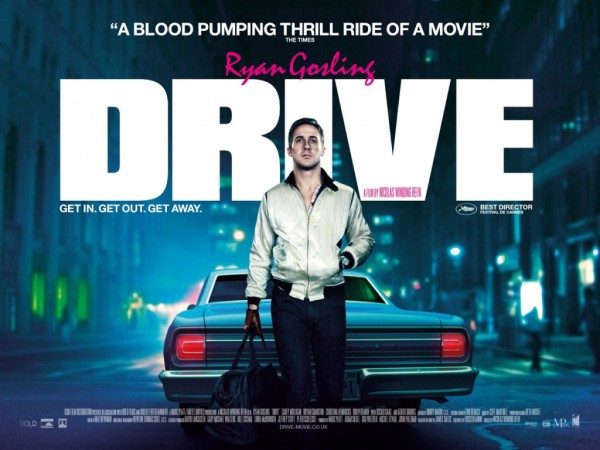
- The Driver - a stand-in for the player's character in GTA. In San Andreas and GTAIV, the RPG elements mean that you can spend a long time just growing your character: going on dates, going to the gym, getting a haircut, doing jobs - some legal, some not - and so on. Then, out of nowhere, you might decide to assault a civilian and stomp them until their blood seeps across the pavement. Just because. It might (and I really hope it is) be entirely at odds with your personality, but there is it: you just squashed prostitute. The Driver, the nameless protagonist in Drive, is a lot like this. He doesn't say much, he splits his time between working in a garage, as a stunt driver and as a getaway driver, and seems like a nice enough guy. Then he'll flip a switch, and excessively murder an assailant, or turn mean and threatening at a moments notice. It's like he's controlled by a person who, due to lack of consequences, decides to go on a rampage out of nowhere.

- It takes inspiration from 1980s set Vice City - the glorious pink typeface that adorns the promotional material is Vice City through and through; the scorpion jacket The Driver wears throughout and the Cadillac he drives is retro in feel; approach to technology is old-school; the neon hues and gaudiness also feel very 1980s; the retro soundtrack is also unashamedly 1980s

- The Driver's missions feel like videogame missions. The opening cat-and-mouse car chase between The Driver and the L.A.P.D feels like a stealth mission: the pang of worry The Driver (or at least the audience) feels when the spotlight singles out his car is not unlike the big exclamation mark that appears above enemies heads in the Metal Gear Solid series. There are on-foot missions: protect Irene from the hitman; defeat the shotgun-wielding thugs; extract information from Cook; the final showdown with Bernie. There are driving missions: the aforementioned night-chase and the escape from the anonymous pursuers after the botched robbery.

- The cosmopolitan array of characters - The white people (The Driver, Irene, Blanche), the Latinos (Standard Gabriel, Benicio), the Jews (Bernie and Nino). I can't remember any black or Asian characters, so maybe it's not that cosmopolitan, but it is still quite. GTA is full of characters of every race and creed imaginable.
- The police give up easily - after The Driver escapes in the opening sequence (possibly too easily: they did have a night-sun after all) the police seem to give up. You can almost see his wanted rating blinking out towards zero. There is no follow-up to the numerous bodies he leaves lying around, and at the end Bernie doesn't even mention any the trouble with the law The Driver might face should he stick around in town.

- Have I mentioned that it revolves around crime yet? That's an obvious one.
- A variety of cars
- Overhead shots of downtown L.A that look exactly like the early top-down GTA games.
P.S I know all the points are labelled point 1, blogger has a whack formatting system that meant I couldn't insert images between bulletpoints.
Friday, 6 April 2012
Filmsoc trip to 'In Bruges'
Spoiler alert: this post will reveal plot points in In Bruges, so if you haven't seen it (and if not, why not?!) be warned.
There is something odd about Bruges. You step off the
bus and before your foot hits Belgian turf it has shoved a chloroform rag over
your mouth and wiped all memories of the outside world.
The place is beautiful, serene and incredibly neatly turned-out, and while she
greets you warmly, openly and friendlily out of the corner of your eye you see
her skilfully shoving reality under the rug with dainty be-clogged feet.
There’s a line in my favourite film, In Bruges, where Ken, played by Brendan Gleeson, bitterly describes
Bruges to his boss, Harry Waters (Ralph Fiennes). “It’s like a fucking
fairytale or something,” he shouts down the phone. Harry sends Ken and Ray
(Colin Farrell) to Bruges to “hide out” after Ray’s first hit goes wrong, and
Ken feels at peace walking among all the old buildings and that. He later finds
out they are not in Bruges simply to hide out, rather Ken is in Bruges, on a
job, on a job in Bruges. Ken feels
tricked by Harry, but also by Bruges itself for being too good to be true, and
resolves to disobey orders even if that may have fatal consequences.
The four days I spent
in Bruges were fantastic. When Filmsoc decided to organise a trip to Bruges, I
didn’t even have to consider it for a moment. A flimsy reason it may be, but my
love for In Bruges is such that I
couldn’t say no. Imagine being invited to visit, say, Minas Tirith from Lord of the Rings, or the Death Star. A
perfect balance was struck between culture and fun, which involved canal trips
and the like in the day followed by getting incredibly wasted and staying out
with great friends until 4am two nights out of three (the first night ended at
a feeble 2am). The magic of Bruges even took effect on my hangover, or lack thereof,
resulting in a far more comfortable coach journey home than anticipated.
Our trip was at an
unfashionable time of year, in a town not renowned for a thriving nightlife, on
Sunday, Monday and Tuesday, so perhaps it was understandable that there were
few people around beyond 12am, but this resulted in the weird feeling that we
had the run of the entire town. Now, alcohol-induced haze may have something to
do with this, but I barely remember encountering a soul while wandering around with
my mates. Consequently, it felt like the bars were there for us specifically,
the locals mere further embellishments of the pretence of realism. There were
some other decidedly surreal moments in our stay, too. We ended up in some
backstreets, and while the main areas were thronging with people these streets
were deserted; how strange then to come upon a huge cathedral, which, as we
were walking past, began to emanate with song. We entered to find a
twenty-strong youth choir performing enthusiastically to an audience of…two. As
with the deserted late-night streets, it was like the town was putting on a
show, literally and figuratively, just for us.
Elsewhere, shortly after arrival we were stood on a corner
getting our bearings, a few of us slightly in the road. Horses and carriages
are two-a-penny in Bruges, but this one, possibly the very first one we saw,
was different. The driver, a woman, was forced to depart from her course by a
few inches so as not to run us oblivious tourists over, resulting her in saying
the most impressively and staggeringly sarcastic thing I've ever hear anyone
say. ‘Keep standing there, well done!’ she beamed at us, ‘no need to move!’ Her
sarcasm was so deep and flawless that it took me a moment to even realise she
was being sarcastic. It was an odd moment in an otherwise completely smooth
stay that in hindsight feels like a crack in the surface.
The last moment I want to recount is when we went up the
famous belfry in the last few hours of our stay. At this point the illusion was
still in place: I was convinced that Bruges was living in a postcard, or a film
set, or a fairytale. The place is a photographer’s dream, point your camera
anywhere are you’ll get a good snap, 100% guaranteed. Up the really windy
spiral staircase I went, singing Raglan Road as I did so, and emerged at the
top. Nearby, a man proposed to his girlfriend. She said yes. I looked over the main
square, and it was lovely. I pretended to shoot someone down below, my fingers
in the shape of a gun, as does Ken in the film. Then I looked up slightly,
beyond the dusty orange rooftops and church spires. And I saw industry. I saw
factories. I saw smoke. I saw the outside world, and felt like I had been
duped. There is an element of exaggeration in this piece, but duped really is
how I felt. It took a while to put my finger on it because when you’re in
Bruges you don’t realise that you’ve fallen for its bewitching charm, but the
power of hindsight indicates this is the case.
This is one of the things Martin McDonagh is getting at in In Bruges. Until this week, I had
forgotten about something he once said about his first visit to Bruges, that it
is perfectly wonderful but also the kind of place that would drive a man mad.
Bruges is somewhere between heaven and hell: the film presents it as purgatory –
it is where Ken, Ray and Harry go to be judged. I’m not so sure. Like the
endless chocolate that fills endless chocolate shops, Bruges is fantastic in
reasonable amounts. Not enough of Bruges and places like it and life would be
too dull, too much and you’ll get fat and die of a heart-attack while
navigating a windy staircase.
Spotters Guide: I slipped in In Bruges references liberally throughout this blog, ten points to Gryffindor
if you spot them all.
Friday, 30 March 2012
Censorship: A Necessary Evil

The above picture illustrates perfectly the role of
censorship in our lives. For whatever reason, we naturally seek out things that
are forbidden or unattainable - a trait so inherent in human nature that it
made it into the Bible as the starting point for humanity. The questionable
factual accuracy of Genesis is irrelevant but the metaphor is solid and it
does absolutely nail the ever recognisable human trait of seeking the
'forbidden fruit' in our lives. Perhaps the most important element in this
story is that the rule-maker (i.e God) acts completely arbitrarily. The apple
is forbidden for no particular reason. Eve recognises this, and starts to
wonder exactly why is the apple forbidden? There must be something about the
apple that she doesn’t know, and this curiosity spurs her to ignore God’s
warnings. She eats it and is cast, along with Adam, out of Eden, igniting
humanity. If that isn’t a reward for disregarding authority then I don’t know
what is.
God’s
decree that Eve shouldn’t eat the fruit is the first evocation of censorship.
In this metaphor, God represents many forms of censors, and censorship. He can
represent parents as censors, the State as censor or prevailing attitudes as
censor – really any authority that enforces arbitrary rules over other people
can be seen as a censor. These entities
are often extremely unpopular, unfair and oppressive. They restrict our
freedoms, make things we like illegal or declare them to be immoral – and yet
they are absolutely essential to society. It is no coincidence that all the
things that the writer of the above picture likes are restricted, in fact, it is
precisely because they are restricted that the writer likes them so much. I
daresay that if God really did not want Eve to eat that apple (and as an
all-knowing being which also created humans, thus having complete insight into
their psyches) he would have gone ‘sure, yeah, whatever, just don’t bother me’
and gone back to reading the paper. The apple would then be boring and Eve
would have left it alone, going on to live a life devoid of all the juicy bits
in a sea of apathy, for all eternity.
Parents
are the first censors that we come across in life. They don’t let us do fun
stuff for any particular reason; they make us go to bed on time; they forbid
swearing; they forbid sex; they forbid drugs; and yes, they forbid rock’n’roll
too (or nowadays, dubstep). I’ve come to believe that it is absolutely
essential that parents bring up their children in this way, and I imagine that
when if or when I become a father it will absolutely kill me to be a boring
tight-arse. We seek out the things that they forbid, and we overindulge. It is
through this overindulgence that we discover what we really like and through
making mistakes we learn our limits…and end up like our parents. It’s a cruel
cycle. Liberal parenting, by which I mean a relaxed attitude to typically
‘forbidden’ things, as attractive as it seems (we all want to be the cool
dad/mum, don’t we?) is probably a bad idea, and it produces spoiled kids. The
children will have nothing to rebel against, and no boundaries will be
pushed.
This
need for something to kick against works on a societal level, too. We relish
liking things that authority figures resent, which is why it is so thoroughly
dispiriting when David Cameron or Gordon Brown claim to like the Arctic Monkeys
or the Smiths. It is understood by absolutely everyone that they are just not
allowed. Politicians, just like parents, have to accept that in assuming a
position of authority they have to bite the bullet and be relentlessly uncool.
Of
course, an essay on censorship would not be complete without covering actual
censorship. In the early 1930s, Hollywood introduced the Hays Code, which, in
short, prevented the depiction of anything remotely controversial. Perhaps the
most famous rule is that a woman must have at least one foot on the ground when
kissing man, otherwise the audience might think that y’know, they might be
doing it, but it also blocks drink, violence and derogatory comments against
the Church. Looking at it nowadays the Hays Code seems incredibly restrictive
and it is a wonder than any good films were made, but made they were.
Filmmakers had to find clever ways to circumvent the censors and the result
were films that could be read in several ways, allowing the audience to fill in
the gaps. Bringing Up Baby (1938), taken at face value, is fairly unremarkable.
However, a clued-up audience would easily be able to understand the endless
euphemisms at work, making it into one of the dirtiest films ever made. One of
the key signifiers in film noir is the lighting of someone else’s cigarette.
This innocuous action is laden with sexual significance, and would not be the
classic image it is today without the prudish influence of censorship. According
to Janet Steiger, ‘censorship opens up, rather than closes down, confessions,
talk, absolution, and resistive transgressions.’ Without censorship, there
would be no pressure on the writers to invent new ways of getting a message
across, and these circumventions created some fantastic films.
Another instance of censorship on the Arts is
the Lady Chatterley’s Lover trial from 1960. Lacy Chatterley’s Lover is a novel
by D.H Lawrence, initially published in 1928. Owing to liberal use of ‘fuck’
and ‘cunt’ and of the groundskeeper Mellors, ahem, fucking Lady Chatterley’s
cunt, it was banned immediately. The novel was in high demand and was devoured
in secret across Europe, until Penguin went ahead and published it in 1960. It
was subsequently tried under the recently created 1959 Obscene Publications
Act. Lady Chatterley won; a precedent
was set. Just this year a group of pornographers were tried for distributing videos of people performing very
deviant sexual acts. Nothing shown was illegal between consenting adults, it
was just weird, man, really weird. They
were nevertheless tried for depravity. Of course, the pornographers won, thus effectively
allowing anything to be film and distributed, providing the on-screen action
was within the boundaries of UK law. Although these two instances seem similar,
there are key contextual differences. With Lady Chatterley, the depictions of
sex scandalised and excited because Britain at the time was sexually very
restrained; with the ‘60s sexual revolution just around the corner Lady
Chatterley represented art catching up with life. In 21st century
Britain, pornography is everywhere, including extreme kinds: this can be seen
as an equivalent to the liberal parenting idea presented earlier. We govern
what we look at and there’s not really much anyone can do to stop us, so the
really hardcore, subversive stuff found in the recent obscenity trial just does
not carry the same sensationalism as Lady Chatterley fifty years previously. Another
good contrast with Lady Chatterley is a film like the Human Centipede. Whereas
Lady Chatterley excited through obscenity, the Human Centipede generally
provokes feelings of disgust, and a ‘eerrr, why did I just watch that?’
attitude. All restraints have been lifted, and we are worse off because of it.
In
fact, the easy access of pornography on the internet is emblematic of how
society has liberalised at large. In generations previously, artistic movements
had the power to shock people. Romanticism, expressionism, modernism and most
recently, post-modernism have all had the power to surprise and startle the
public. These periods have all developed under the pressure of censorship, this
time in the form of taste. People have been known to riot during the debut of
certain pieces of experimental classical music so did they offend the taste of
the audience. Consistent liberalising of attitudes towards pretty much
everything has meant that the closest we can get to rioting off the back of a
piece of art is from the ultra-shit like Rebecca Black. Furthermore, because it
is so hard to be controversial any more no one is really sure what artistic
movement we are going through, if there is one at all. The impression is that
the winds on the cultural high-seas have died down, leaving us drifting
aimlessly and directionless.
This
essay has put me in a tricky position. I consider myself to be liberal. I support
gay rights, and have an open mind when it comes to music and film, and I even
feel people should decide what they want to watch. And yet, here I am,
advocating the opposite (EDIT - except that gay rights bit. That should always stand. Badly worded sentence). I think it’s time that the government started acting
like the strict, boring, curmudgeonly parent it should be. It needs to ban
stuff, even if logic says that it shouldn’t. Maybe the internet should be
restricted, even though that would make me rage for months. Maybe political
radicals should be clamped down on, just so that we can get wound up about
something again. The apple must be forbidden once more.
Friday, 23 March 2012
Cloverfield and Hand-Held Camera Storytelling
Much like King Kong (last time I mention it for a while, I promise), Cloverfield (Matt Reeves, 2008) is another film that divided audiences. Some found the hand-held camera nauseating, others described it as "gimmickry" or "YouTube storytelling" (quotes culled from Rotten Tomatoes, cba to fully reference them), or as just another way of telling a traditional narrative. The characters picked up a lot of slack, mostly for being boring yuppies with bad decision-making skills. Get your brains in gear, reviewers.
The most important thing to realise about Cloverfield is that it's not really about the boring New York yuppies. Cloverfield is about the wider picture, of which we get only the tiniest of glimpses: we are locked, from start to finish, into the literal view of ordinary civilians, and we know just the smallest amount more than they (thanks to the incredibly successful viral campaign). We may follow these people for the duration of the film, but essentially they serve as one small perspective on a much larger event. Criticisms that it "lacks tension" are deflected when looked at like this: horror is at its most effective when it is left to our imagination, and Cloverfield works in this same way. The Rob/Beth narrative may not be fantastic or tense, but the glimpses we do get of New York, of the lives of other civilians, of the actions of the military compensate fully. Take for instance the opening title that frames the footage as military evidence. It poses so many questions - what is the state of the US currently? Is the monster still alive? Did it win? Are there other such stories to be told? It expands the story hugely, but crucially this expansion happens only in our imaginations. We are able to create a far more cohesive world than the filmmakers could have, even if the film took a broader view of events.
For this reason Cloverfield is so much more than a "traditional narrative". Keeping the audience in a position of ignorance is fundamentally different from showing the wider picture with different angles and perspectives. Cloverfield doesn't really have an ending. The movie finishes when the camera is lost beneath a collapsed bridge, and while this concludes the Rob/Beth narrative, the story of the monster, which is the main narrative, is far from finished. The hand-held camera format can successfully be accused of "gimmickry" at times - see recent release Project X - but here it is just not the case.
I would go so far as to argue that because the 'monster narrative' is the real core of the film, it doesn't matter that the Rob/Beth narrative isn't that great. The characters are mostly boring, they're a homogeneous bunch taken from a section of society with which most of the audience would have little sympathy with: they're rich, pretty and self-absorbed. Only the Lizzy Caplan character has anything remotely interesting about her. What this serves to do, however, is increase the verisimilitude of the film. It is precisely because they're so mundane that it works - their lack of wit, their irrational decision-making and general helplessness makes them feel like normal people. In subservience to the 'monster narrative' it is more important that the characters are believable New Yorkers than fascinating people. If anything, it is good that the focus is on the wider events; if the 'monster narrative', a nuanced and beguiling character narrative and the audience assimilation into the film through the immediacy of the hand-held camera were all woven together it may well be that Cloverfield would be too cluttered, and the least important is the character narrative.
Had the film been shot like a normal film, yet kept the same level of audience ignorance, it would have been much less effective. We would get impatient, and start wondering why we're not being given any context. Then, when the characters die at the end and the film finishes it would feel like a con. The restrictions would seem incredibly arbitrary and frustrating. Setting Cloverfield up as camcorder footage circumvents this issue entirely - we are happy to accept this as how the film works, and it makes sense that we are left in the dark on the events unfolding in wider New York.
It is worth mentioning that Cloverfield has a 77% approval rating on Rotten Tomatoes, so it was a far from reviled film. It was praised for the level of immersion and the spectacular set-pieces, but I felt that there is a general under-appreciation of how ably it uses the hand-held format. Hopefully this piece provides a counterpoint.
The most important thing to realise about Cloverfield is that it's not really about the boring New York yuppies. Cloverfield is about the wider picture, of which we get only the tiniest of glimpses: we are locked, from start to finish, into the literal view of ordinary civilians, and we know just the smallest amount more than they (thanks to the incredibly successful viral campaign). We may follow these people for the duration of the film, but essentially they serve as one small perspective on a much larger event. Criticisms that it "lacks tension" are deflected when looked at like this: horror is at its most effective when it is left to our imagination, and Cloverfield works in this same way. The Rob/Beth narrative may not be fantastic or tense, but the glimpses we do get of New York, of the lives of other civilians, of the actions of the military compensate fully. Take for instance the opening title that frames the footage as military evidence. It poses so many questions - what is the state of the US currently? Is the monster still alive? Did it win? Are there other such stories to be told? It expands the story hugely, but crucially this expansion happens only in our imaginations. We are able to create a far more cohesive world than the filmmakers could have, even if the film took a broader view of events.
For this reason Cloverfield is so much more than a "traditional narrative". Keeping the audience in a position of ignorance is fundamentally different from showing the wider picture with different angles and perspectives. Cloverfield doesn't really have an ending. The movie finishes when the camera is lost beneath a collapsed bridge, and while this concludes the Rob/Beth narrative, the story of the monster, which is the main narrative, is far from finished. The hand-held camera format can successfully be accused of "gimmickry" at times - see recent release Project X - but here it is just not the case.
I would go so far as to argue that because the 'monster narrative' is the real core of the film, it doesn't matter that the Rob/Beth narrative isn't that great. The characters are mostly boring, they're a homogeneous bunch taken from a section of society with which most of the audience would have little sympathy with: they're rich, pretty and self-absorbed. Only the Lizzy Caplan character has anything remotely interesting about her. What this serves to do, however, is increase the verisimilitude of the film. It is precisely because they're so mundane that it works - their lack of wit, their irrational decision-making and general helplessness makes them feel like normal people. In subservience to the 'monster narrative' it is more important that the characters are believable New Yorkers than fascinating people. If anything, it is good that the focus is on the wider events; if the 'monster narrative', a nuanced and beguiling character narrative and the audience assimilation into the film through the immediacy of the hand-held camera were all woven together it may well be that Cloverfield would be too cluttered, and the least important is the character narrative.
Had the film been shot like a normal film, yet kept the same level of audience ignorance, it would have been much less effective. We would get impatient, and start wondering why we're not being given any context. Then, when the characters die at the end and the film finishes it would feel like a con. The restrictions would seem incredibly arbitrary and frustrating. Setting Cloverfield up as camcorder footage circumvents this issue entirely - we are happy to accept this as how the film works, and it makes sense that we are left in the dark on the events unfolding in wider New York.
It is worth mentioning that Cloverfield has a 77% approval rating on Rotten Tomatoes, so it was a far from reviled film. It was praised for the level of immersion and the spectacular set-pieces, but I felt that there is a general under-appreciation of how ably it uses the hand-held format. Hopefully this piece provides a counterpoint.
Tuesday, 28 February 2012
King Kong: New Versus Old
So after not posting for a few weeks, when I do decide to do another one it's on the same subject as the last one: King Kong. Now, for some reason I seem to end up talking about King Kong a lot, and I'm not sure why really. I suppose it's because I like it and seem to be one of the few able to sit through it without getting bored by its hefty runtime - the major complaint, alongside Jack Black as Carl Denham (who I actually like, more on whom later). Perhaps I'm a Kong apologist, who knows: onward regardless.
The 1933 original which I watched for the first time today is generally (universally?) seen as the best version, and indeed, one of the best films of all time. This view is seriously rose-tinted. It's all about empathy.
In the original, Kong is a wild beast. He's animalistic. He's insensitive. He lacks empathy. While pursuing the fleeing Ann Darrow in both Skull Island and in New York, Kong eats (or at least gnaws at) a fairly off-putting number of people. He just picks them up, chews them for a moment then flings them to the ground. Essentially, Kong is a more accurate - if you can even use 'accurate' in describing a fantastical creature - representation of what a giant ape would be like. That could be fine handled differently, but it presents a few narrative problems. Kong's attraction to Darrow is no more profound than a magpie's attraction to a shiny coin. He is fascinated by her whiteness: all previous sacrifices have been black girls who are apparently only attractive enough to eat (the 1930s were less than racially aware). He wants no more than to hold her in his mighty fist, and never looks at Darrow beyond her whiteness.
Because of this, Darrow shows no emotion towards Kong other than fear. She doesn't interact with him at all - in fact, she says almost nothing for the remainder of the film once taken by Kong, instead she shrieks and shrieks. Well renowned film critic Richard Corliss from Time Magazine says Darrow came to sympathise with the beast. This is simply untrue: there is no evident emotional connection between Darrow and Kong. She says nothing (verbally or physically) to him, and even in the climactic scene atop the Empire State Building her anguish is not for Kong being slowly killed by the biplanes but for being stranded 381 metres above the streets below supported only by an out-of-control beast. Jay Antani, who mounts the most persuasive case against the remake, takes the view that the tragedy of Kong is his role as 'an outcast/schoolyard bully who falls in love with the local beauty–a woman who will never accept him'. How two-dimensional is that? Their entire dynamic can be explained in one scene, with no further development needed: Kong likes woman, woman resists. It doesn't change for the rest of the film. Dull!
There is an empathetic collapse here, and the problems with that are obvious. There is no emotional pull for the audience. In the remake we, channeled though Darrow, slowly come to understand Kong. As a character he is far, far more complex than in the original; the Kong we see in the original is the same Kong that the supporting characters see in the remake - it is through Darrow's interaction and gradually developing empathy for Kong that we come to understand him. This window is lacking in the original.
The second problem with having no connection between Kong, Darrow and the audience is that the action scenes have no emotional weight. The T-Rex fight may be animated with great skill, but without empathy for Kong we don't know whether we should be rooting for him or not. Sure, if the T-Rex wins Darrow will get eaten, but it's not clear whether Kong has dinner plans for Darrow or merely wants to keep her around to do...what, exactly? Manhandle her until she slowly starves? That doesn't sound a whole lot better than getting eaten by a dinosaur.
In contrast, the T-Rex fight in the remake is driven by character. Rather than just being a fight scene in the shallowest sense, it is a way (a really awesome way, I might add) of developing the Darrow/Kong relationship. Kong is enraged that Darrow has escaped, so sets of in pursuit and in doing so winds up having to defeat three T-Rexes while keeping her safe. At this point we are far more invested in both Darrow and Kong than in the original: we see Darrow trying to entertain Kong, we see her gradual understanding, and we understand the simple enjoyment Kong gets out of watching her perform. By making it clear that the audience is on the side of Darrow and Kong, the fight becomes far more engaging: Kong has to viciously fight these enormous creatures while keeping her safe. In comparison with the original, Kong has a far greater task.
Furthermore, once the fight is over, Kong does not simply snatch Darrow up and carry her off again, he gets upset. She has offended him. The contrast between his bravery and power in battle and his sensitivity afterwards is fascinating. Perhaps this was enabled by technology: Kong is as expressive as any human. Would this emotional detail have been possible with the crude methods available to the original? In that film a close up of Kong's face caused ripples of laughter among my coursemates - he looked like a gurning moron. The remade Kong has infinitely more depth. I would argue that this is a rare instance of technology actually being put to use for narrative purposes, instead of just making things looks better.
Lastly, a few other quick points. As neatly articulated by Jay Antani, 'in the original, Driscoll was the ship’s first mate; here, he’s Denham’s screenwriter and, hence, the Denham-Darrow-Driscoll triangulation is made more taut.' Yep. The biplane fight is shot far better than in the original. Kong is shot from further out, emphasising his impotence against the aerial threat. Denham is actually really good, even played by Jack Black. In the original he's stiff and uninteresting, in the remake he's wonderfully flawed. Jack Black is very unheroic and quite ridiculous by nature and it suits this new Denham perfectly. There is also the question of whether Darrow loves Kong. It's not obvious, and I'm not sure of the answer.
The 1933 original which I watched for the first time today is generally (universally?) seen as the best version, and indeed, one of the best films of all time. This view is seriously rose-tinted. It's all about empathy.
In the original, Kong is a wild beast. He's animalistic. He's insensitive. He lacks empathy. While pursuing the fleeing Ann Darrow in both Skull Island and in New York, Kong eats (or at least gnaws at) a fairly off-putting number of people. He just picks them up, chews them for a moment then flings them to the ground. Essentially, Kong is a more accurate - if you can even use 'accurate' in describing a fantastical creature - representation of what a giant ape would be like. That could be fine handled differently, but it presents a few narrative problems. Kong's attraction to Darrow is no more profound than a magpie's attraction to a shiny coin. He is fascinated by her whiteness: all previous sacrifices have been black girls who are apparently only attractive enough to eat (the 1930s were less than racially aware). He wants no more than to hold her in his mighty fist, and never looks at Darrow beyond her whiteness.
Because of this, Darrow shows no emotion towards Kong other than fear. She doesn't interact with him at all - in fact, she says almost nothing for the remainder of the film once taken by Kong, instead she shrieks and shrieks. Well renowned film critic Richard Corliss from Time Magazine says Darrow came to sympathise with the beast. This is simply untrue: there is no evident emotional connection between Darrow and Kong. She says nothing (verbally or physically) to him, and even in the climactic scene atop the Empire State Building her anguish is not for Kong being slowly killed by the biplanes but for being stranded 381 metres above the streets below supported only by an out-of-control beast. Jay Antani, who mounts the most persuasive case against the remake, takes the view that the tragedy of Kong is his role as 'an outcast/schoolyard bully who falls in love with the local beauty–a woman who will never accept him'. How two-dimensional is that? Their entire dynamic can be explained in one scene, with no further development needed: Kong likes woman, woman resists. It doesn't change for the rest of the film. Dull!
There is an empathetic collapse here, and the problems with that are obvious. There is no emotional pull for the audience. In the remake we, channeled though Darrow, slowly come to understand Kong. As a character he is far, far more complex than in the original; the Kong we see in the original is the same Kong that the supporting characters see in the remake - it is through Darrow's interaction and gradually developing empathy for Kong that we come to understand him. This window is lacking in the original.
The second problem with having no connection between Kong, Darrow and the audience is that the action scenes have no emotional weight. The T-Rex fight may be animated with great skill, but without empathy for Kong we don't know whether we should be rooting for him or not. Sure, if the T-Rex wins Darrow will get eaten, but it's not clear whether Kong has dinner plans for Darrow or merely wants to keep her around to do...what, exactly? Manhandle her until she slowly starves? That doesn't sound a whole lot better than getting eaten by a dinosaur.
In contrast, the T-Rex fight in the remake is driven by character. Rather than just being a fight scene in the shallowest sense, it is a way (a really awesome way, I might add) of developing the Darrow/Kong relationship. Kong is enraged that Darrow has escaped, so sets of in pursuit and in doing so winds up having to defeat three T-Rexes while keeping her safe. At this point we are far more invested in both Darrow and Kong than in the original: we see Darrow trying to entertain Kong, we see her gradual understanding, and we understand the simple enjoyment Kong gets out of watching her perform. By making it clear that the audience is on the side of Darrow and Kong, the fight becomes far more engaging: Kong has to viciously fight these enormous creatures while keeping her safe. In comparison with the original, Kong has a far greater task.
Furthermore, once the fight is over, Kong does not simply snatch Darrow up and carry her off again, he gets upset. She has offended him. The contrast between his bravery and power in battle and his sensitivity afterwards is fascinating. Perhaps this was enabled by technology: Kong is as expressive as any human. Would this emotional detail have been possible with the crude methods available to the original? In that film a close up of Kong's face caused ripples of laughter among my coursemates - he looked like a gurning moron. The remade Kong has infinitely more depth. I would argue that this is a rare instance of technology actually being put to use for narrative purposes, instead of just making things looks better.
Lastly, a few other quick points. As neatly articulated by Jay Antani, 'in the original, Driscoll was the ship’s first mate; here, he’s Denham’s screenwriter and, hence, the Denham-Darrow-Driscoll triangulation is made more taut.' Yep. The biplane fight is shot far better than in the original. Kong is shot from further out, emphasising his impotence against the aerial threat. Denham is actually really good, even played by Jack Black. In the original he's stiff and uninteresting, in the remake he's wonderfully flawed. Jack Black is very unheroic and quite ridiculous by nature and it suits this new Denham perfectly. There is also the question of whether Darrow loves Kong. It's not obvious, and I'm not sure of the answer.
There. That was my attempt at doing some serious analysis, Film Crit Hulk style.
Subscribe to:
Posts (Atom)